Author: Laurentiu Nicolae – co-founder, Nutritio
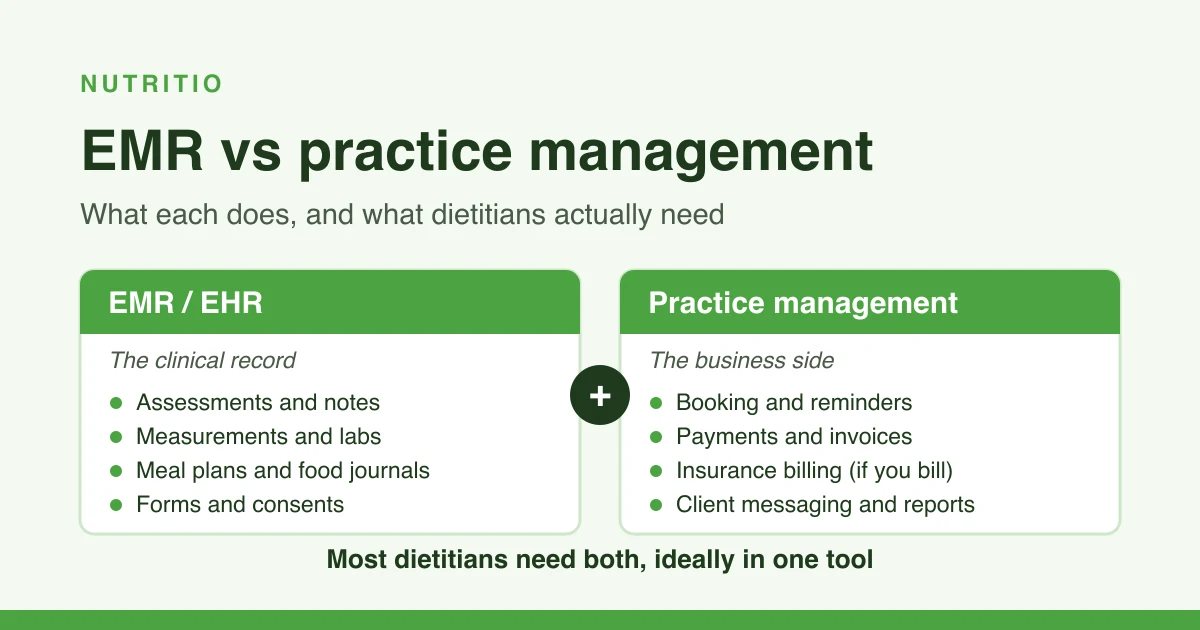
Short answer: an EMR or EHR holds the clinical record: assessments, notes, plans and progress. Practice management software runs the business: scheduling, reminders, payments and billing. Most dietitians need both, ideally in one tool. What decides the choice is whether you bill insurance, how you chart, and whether you also build meal plans and follow up with clients.
EMR, EHR and practice management: what is the difference?
The three terms are used loosely, and vendors often mix them. In practice:
- EMR (electronic medical record): the digital version of a patient chart inside one practice. Think assessments, notes, measurements, lab values, care plans and consent forms.
- EHR (electronic health record): the same idea, but built so the record can be shared across providers and organizations. For a solo dietitian the difference rarely matters. For a clinic with several providers, it can.
- Practice management software: everything around the chart. Calendar and online booking, intake forms, reminders, payments and invoices, insurance claims, client messaging and reporting. Many dietitians also call this a nutrition CRM.
A tool that does both is usually sold as an EHR with practice management, or as an all-in-one platform. You can see how this looks for a nutrition practice on our practice management software page.
What a dietitian’s EMR actually needs
General medical EHRs are built around diagnoses and prescriptions. A dietitian’s record is different. Before you pay for anything, check that it handles:
- Nutrition assessment and notes in the format you chart, such as SOAP, or ADIME from the Nutrition Care Process, with reusable templates.
- Measurements over time: weight, waist, hips, BMI, labs and anything you track for your clients.
- Meal plans and food journals attached to the client record. If these live in a separate app, you re-enter data and lose the history.
- Forms and questionnaires that clients can fill in before the first visit.
- Secure messaging and video calls, with privacy controls that match your market. In the US, that means HIPAA safeguards and a business associate agreement (BAA) with the vendor. In the EU, GDPR.
- Data export, so you are never locked in.
What practice management needs to do
This is the business side, and it is where many nutrition practices lose hours each week:
- Scheduling and online booking with automatic reminders that cut no-shows.
- Payments: payment links, packages and invoices.
- Billing, which is the big fork in the road, covered below.
- Client communication in one place instead of email, text and chat threads.
- Reporting, if you have staff or more than one location.
Do you need insurance billing?
This single question narrows the field more than any feature list.
- Cash-pay or program-based practice: you need payments, packages and invoices, not claims. A nutrition-specific all-in-one platform is usually enough and costs less.
- Insurance-based practice (mostly in the US): you submit claims for medical nutrition therapy, for example with CPT codes 97802, 97803 and 97804 for individual and group visits. Coverage rules vary by payer, so check with the payers you work with. You need eligibility checks, claim submission and payment posting, which means a platform with real insurance billing or a separate billing tool.
If claims are central to your income, look at EHRs that lead on insurance billing and charting. On our software comparison we say plainly where Healthie, Practice Better and Jane App are stronger than Nutritio on that side. If you are starting to work with insurers, read how to start working with insurances as a dietitian first.
Three common setups
- Online coach or cash-pay dietitian. One platform for client records, meal plans, food journals, booking and payments. Priority: nutrition tools and a client app, not claims.
- Insurance-based private practice. An EHR with billing for notes, scheduling and claims, plus a nutrition tool or integration for meal plans, if the EHR does not have one.
- Clinic with several providers or locations. Role-based access, shared calendars, reporting across providers and sites, and often your own branded client app. This is where software for nutrition clinics and multi-location tools matter.
A short checklist before you choose
- Does it protect client data the way your market requires, and will the vendor sign a BAA if you need one?
- Can you chart in the format you use, with templates?
- Are meal plans and food journals part of the client record? See what meal planning software should do for you.
- Does it include a client app, and can it carry your own branding?
- How are payments handled, and what does billing support cover?
- Does the price scale per provider, per client, or per location?
- Is there onboarding help, and can you export your data later?
- Does it fit how big you will be in a year, not only today?
Where Nutritio fits
Nutritio is built around nutrition work. Each client has one record with their meal plans, food journals, progress data, forms and appointments, and AI helps generate meal plans and consultation notes. It includes scheduling and self-booking, Stripe payment links, a client portal and mobile app, and white-label and multi-location options for clinics and wellness brands.
It is not built around insurance claim submission. If your practice depends on that, compare it with the billing-focused tools above. You can start with a free 14-day trial and judge it on your own workflow.
Quick answers
Is an EMR the same as an EHR? Not exactly. An EMR is the chart inside one practice; an EHR is designed to be shared across providers. For a solo dietitian, the two terms are usually interchangeable.
Can I use practice management software without an EMR? Yes, if you only need booking, reminders and payments. But you will keep clinical notes and measurements somewhere else, which gets awkward as your client list grows.
Do I need a general EHR as a dietitian? Only if you bill insurance or work inside a health system that requires one. Otherwise a nutrition-specific platform is simpler and usually cheaper.